I Don’t Regret Sending This. I’m Not Proud of It Either.
A few days ago, I unblocked my former baseball coach on LINE.
I sent him one of the harshest messages I’ve ever sent another person.
Almost immediately, LINE marked it Read. He happened to be looking at his phone when I sent it, apparently.
Then I blocked him.
I was going to block him either way. Whether he read it immediately, ten minutes later, or not at all didn't change the plan. I hadn't unblocked him because I wanted a conversation. I had unblocked him because, after months of saying nothing directly to him, there was something I had decided I wanted to say.
Once I'd said it, I was done.
I don't regret sending it.
I'm also not proud of it.
I've spent some time wondering whether those two statements contradict each other. I've decided they don't.
Regret would mean that, given the opportunity to go back to that morning and stop myself from pressing send, I would.
I wouldn't.
I'm glad I sent it. It was cathartic as hell.
But being glad I finally said something doesn't mean I'm proud of everything I chose to say. There are things in that message that were deliberately cruel. There were subjects I knew would hurt him, and I brought them up knowing exactly that.
I wasn't blindly lashing out.
I knew what I was doing.
That's mine to own.
But if I'm going to publish the message I sent him, I don't think it makes sense to drop it here without showing what came before it. Otherwise you get the explosion without seeing the months of pressure that preceded it.
So I'm going to do something I normally wouldn't do.
I'm going to show the conversations.
Not selected quotes rewritten from memory. Not my reconstruction of what somebody supposedly said. The actual messages.
You can read them and decide for yourself what you think of them.
This is what I experienced.
It started with a fucking profile picture
This was one of the first major arguments.
I changed the profile picture used by the team without asking the other people involved in management first.
Let's get something out of the way immediately:
I shouldn't have done that.
It was a public-facing account representing the team. There were other people involved in management. Asking first would have taken me thirty seconds.
That's mine.
But what happened afterward became an early example of why communicating with Henry eventually exhausted me.
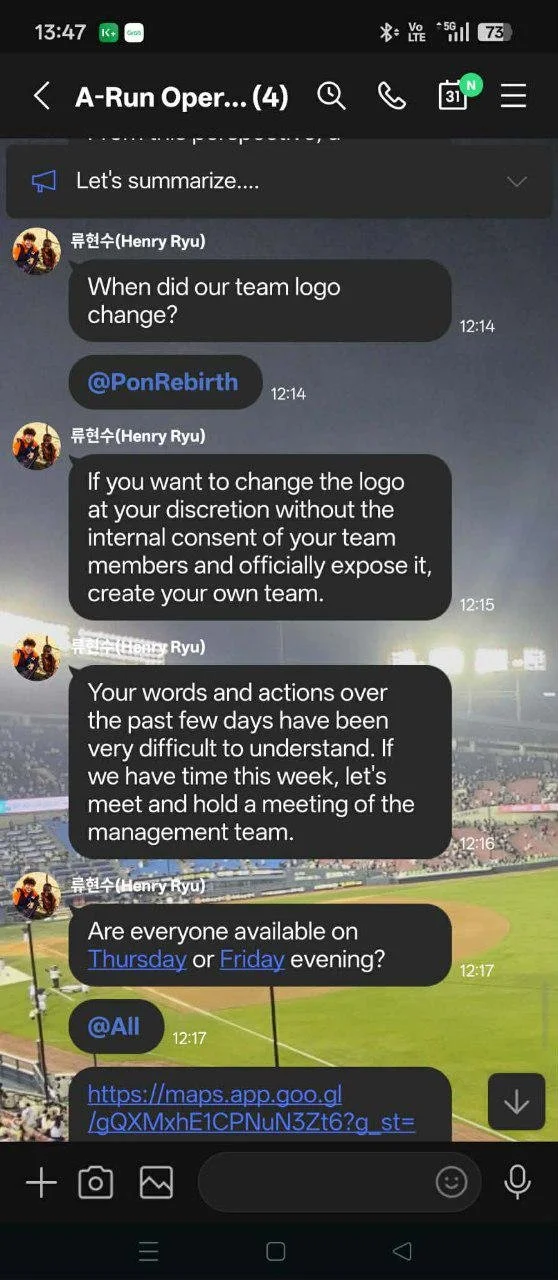
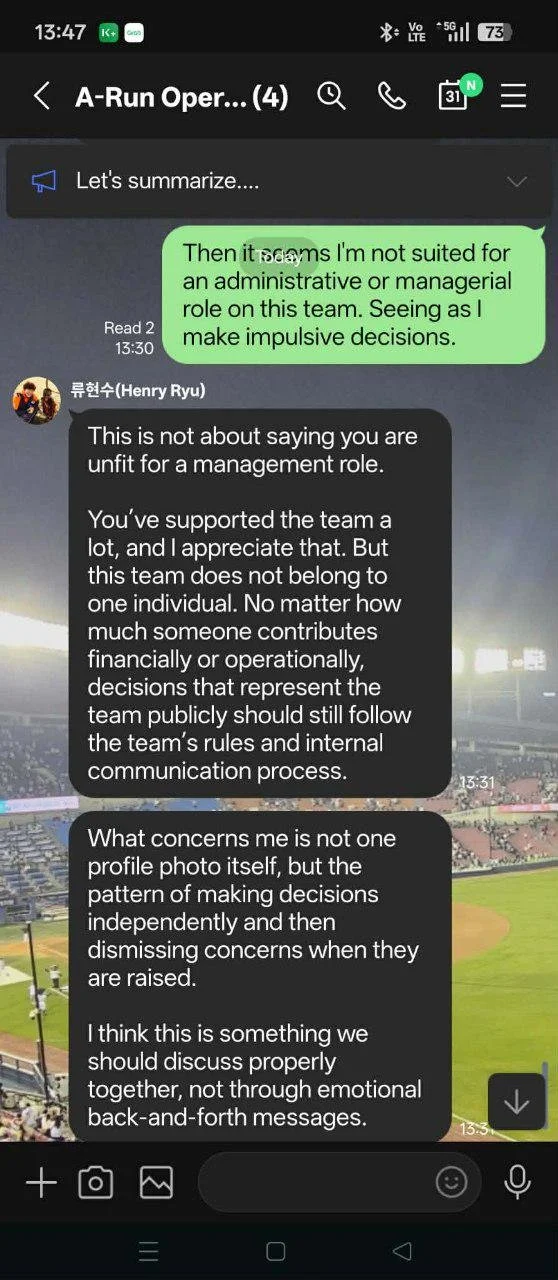
Henry asked when “our team logo” had changed.
Then came:
“If you want to change the logo at your discretion without the internal consent of your team members and officially expose it, create your own team.”
A minute later:
“Your words and actions over the past few days have been very difficult to understand.”
And immediately after that, he proposed a management meeting.
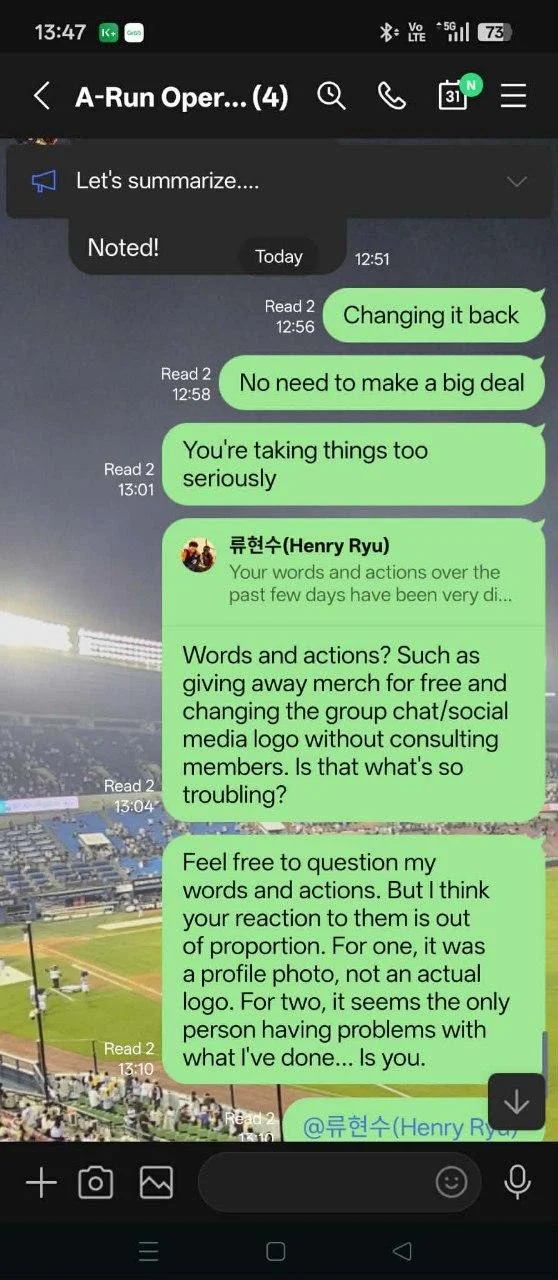
I changed the profile picture back.
I told him there was no need to make a big deal about it. I told him he was taking it too seriously. I said his reaction seemed out of proportion.
Those responses weren't particularly diplomatic either. Reading them now, I can understand why telling somebody that their concern is “out of proportion” isn't exactly an invitation to productive discussion.
But this is also where our fundamental problem becomes visible.
I thought we were arguing about a profile picture.
Henry said we weren't.
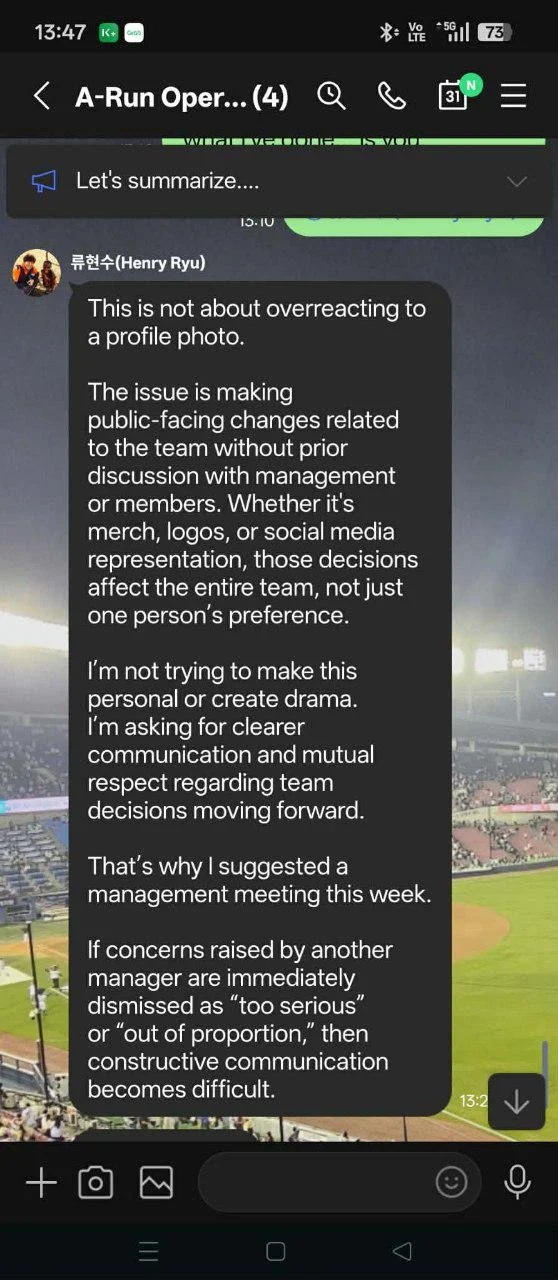
“This is not about overreacting to a profile photo.”
According to him, the real issue was public-facing decisions, internal communication and mutual respect.
There is a reasonable point in there.
Then it expanded.
What concerned him wasn't the profile picture itself anymore. It was:
“the pattern of making decisions independently and then dismissing concerns when they are raised.”
Now we weren't discussing one decision.
We were discussing a pattern in me.
And apparently that pattern required an in-person management meeting rather than what I thought could have been resolved with:
“Pon, ask us before changing public-facing stuff next time.”
“Okay.”
Done.
Instead, the profile-picture incident became something larger: my judgment, my behavior, how I responded to concerns and what those things supposedly revealed about me.
That phrase stayed with me.
So did another one:
“Create your own team.”
Neither of us knew how funny that sentence would eventually become.
Then came the version of me I wasn't in the room to hear about
Before one of our later meetings, another person involved in management, P'Teng, messaged Henry in the operations chat.
I eventually saw that conversation.
This is it.
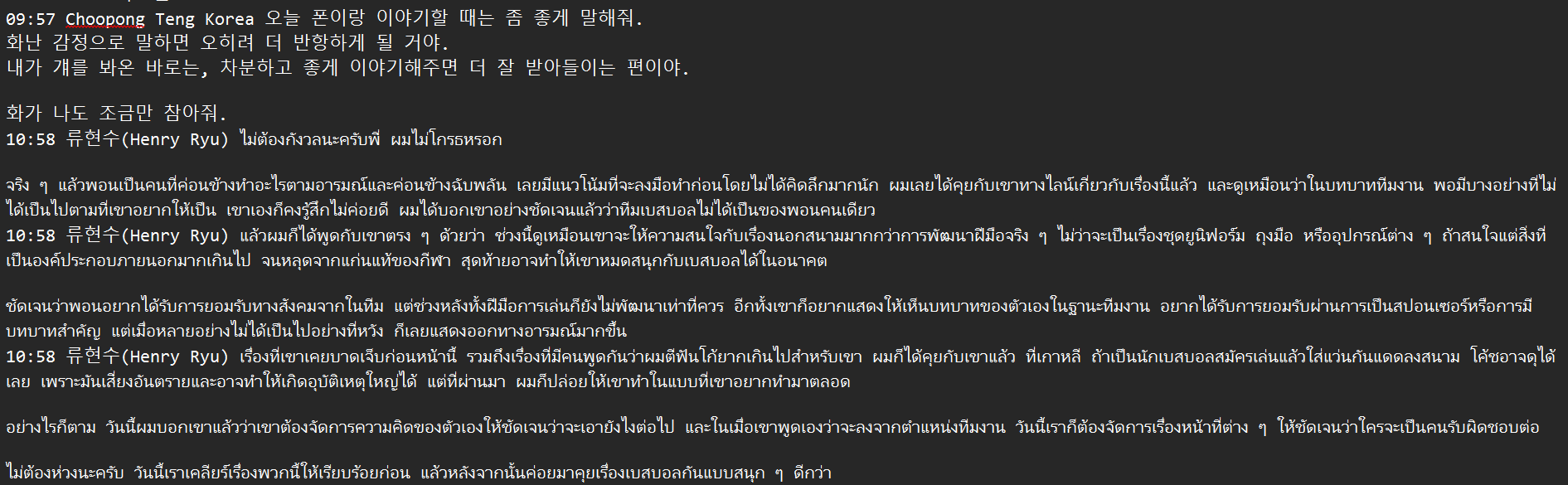
P'Teng essentially tells Henry to speak nicely to me. He says that if Henry speaks angrily, I'll become more resistant, and that from what he's observed, I respond better when somebody speaks calmly. He asks Henry to hold his anger back a little.
Henry replies that he isn't angry.
Then he starts explaining me.
According to Henry, I was emotional and impulsive.
I acted before thinking deeply.
I felt bad when things didn't go the way I wanted.
I had become too interested in things outside baseball: uniforms, gloves and equipment.
My playing hadn't developed as much as it should have.
Then came the part that still fascinates me.
Henry said it was “clear” that I wanted social recognition from the team.
Apparently I wanted recognition through sponsorship and having an important role, and because several things hadn't gone the way I'd hoped, I had become more emotional.
Maybe Henry sincerely believed all of that.
Maybe there were things about my behavior that genuinely frustrated him.
But here's the problem:
He didn't fucking know what was inside my head.
Neither do I know what was inside his.
I can describe his behavior. I can tell you what I thought it meant. I can tell you how it made me feel.
I cannot announce his motivations as fact.
And yet here was somebody who repeatedly stressed the importance of direct communication, explaining my supposed motivations to other people before we had even sat down together.
That contradiction stayed with me.
Then came the conversation that broke whatever was left
What follows is the longest exchange.
I'm including the whole thing rather than selecting only the messages that make me look good.
It’s excruciatingly long.
I know.
Imagine fucking participating in it.
But the length matters because the pattern becomes much easier to understand when you read the conversation from beginning to end.
Henry starts by telling me that if I have frustrations or concerns with him, I should speak to him directly. He doesn't want misunderstandings growing through indirect conversations.
Again: remember the previous screenshot.
Then he brings up an injury I'd suffered at Sathon.
He had heard that I believed the injury happened because of him and that I felt he'd hit balls differently toward me than toward other players. His response included an explanation about how sunglasses might be viewed in Korean amateur baseball and how they could potentially interfere with visual judgment.
Then the subject expanded.
He told me my focus had gradually shifted away from baseball itself and toward:
“sponsorship discussions, uniforms, conversations in the group chat, and other external matters.”
Which was interesting because sponsorships, uniforms and communication were among the operational responsibilities I had actually been handling.
Then came this:
“If your commitment to improving as a player and contributing to the team does not become your priority again, then as a coach, I will need to seriously reconsider your role and position within the team.”
That sentence still makes me laugh a little.
Not because there was nothing serious underneath it.
Because this was an amateur recreational baseball team.
I have a job.
I have family.
I have friends.
I have responsibilities.
I have an entire life that continues to exist Monday through Saturday.
I love baseball.
I can care deeply about baseball without making baseball my life.
So if recreational baseball wants to become my priority, it can get in fucking line.
I tried to explain what was actually exhausting me
I told Henry that I had already stepped away from operations because I didn't want to keep clashing with him. I told him I was mentally and emotionally exhausted.
His response:
“You are misunderstanding my point.”
Then:
“This is not about logistics, sponsorships, social media, or the operational boundaries we agreed on earlier this year.”
Now it was about my attitude on the field. How I handled mistakes. How I responded to frustration and criticism. How I communicated concerns. How I supposedly carried dissatisfaction internally.
Then my exhaustion itself became part of the lesson.
Being mentally and emotionally exhausted, he told me, wasn't an excuse to “carry resentment silently and then project it onto others.” If baseball had become draining, I needed to reflect on why and why I had chosen to carry that alone instead of addressing it “like an adult and like someone in a leadership position.”
So I corrected him.
Baseball wasn't draining me.
Operations were.
Constantly clashing with Henry was.
I told him exactly what I wanted:
Show up.
Play catch.
Field some balls.
Maybe bat if we had time.
I didn't want to run anything anymore.
I just wanted to play baseball.
His response began:
“Alright.”
Great.
Problem solved?
No.
Apparently I needed to prove I could be a normal baseball player correctly
Henry told me to focus on becoming a better player.
Stop comparing myself to others.
Put my energy into development.
Other players knew where their skill level was, he said, and instead of complaining or comparing themselves to other people, they kept showing up and improving.
My injury should have been “an opportunity for reflection and growth.”
Then:
“Are you willing to put in the work that requires?”
He told me that when he was serious about baseball, he trained every day, exercised, studied rules, simulated situations and constantly worked to understand the game.
Improvement came from:
“discipline, repetition, humility, and effort.”
If I really wanted to step away from operations and simply play baseball, apparently I needed to “commit fully to that path.”
Then came chasing balls.
Helping without being asked.
Doing the little things.
Those things showed what kind of player I was.
Skill could be developed.
Attitude was a choice.
And this is where I snapped back.
Because Henry questioned my willingness to contribute to the team.
Whatever else he wanted to criticize about me, that one hit differently.
I'd poured an enormous amount of myself into ARUN.
Recruitment. Announcements. Welcoming new players. Helping beginners. Social media. Uniforms. Equipment. Sponsorship. Administration. Money. Time. Energy.
I told him that.
Henry acknowledged it.
Then he told me I was looking at things “too narrowly.”
I needed to look at the bigger picture. The full picture.
And then we arrived at sacrifice.
“But have I ever complained about that?”
This remains one of my favorite parts of the entire conversation, although probably not for the reason Henry intended.
Henry told me:
“Honestly, I think you are only looking at your own sacrifices right now.”
Then:
“The truth is, I have sacrificed far more for this team than you may realize.”
He listed some of those sacrifices.
He paid the same membership fee as everyone else.
He showed up on days when he wasn't physically well or had personal matters to deal with.
Those things I can understand. Giving your time when you have other things going on can absolutely be a sacrifice.
Then there was this:
“Have you ever seriously thought about what it means to spend that time hitting fungos for others instead of playing for yourself?”
Yes, Henry.
I have.
You were the fucking coach.
Hitting fungos wasn't some extraordinary act of self-denial bestowed upon the rest of us by a baseball martyr.
It was coaching.
You were the person running practice. Hitting fungos so players could take fielding repetitions was about as close to the bare minimum of that role as I can imagine.
I'm not saying coaching requires no sacrifice. Of course it does. Coaching means spending time teaching other people when you could be playing yourself. It means organizing drills, watching players, correcting mistakes and sometimes putting other people's development ahead of your own enjoyment.
But if you voluntarily take on the role of coach, performing the basic function of coaching isn't automatically evidence that you've sacrificed more than everybody else.
You don't get to appoint yourself coach and then submit the job description as evidence of martyrdom.
Henry continued:
“I want to catch.”
“I want to pitch.”
“I want to play freely in the positions I enjoy.”
Then came the masterpiece:
“But have I ever complained about that?”
And:
“Have I ever made this about my own situation?”
Henry.
You were complaining about it while asking me whether you had ever complained about it.
You were describing everything you'd rather be doing, explaining everything you'd supposedly given up, telling me you'd sacrificed “far more,” and then asking whether you'd ever made things about your own situation.
I genuinely don't know what else to call that.
I tried to stop the comparison.
I acknowledged that we'd both had visions for the team and that I'd stepped away from mine precisely because I didn't want to keep fighting over them. I told him we could keep going back and forth over who had sacrificed more, but that the conversation would probably just leave both of us mentally drained.
Henry's response:
“What I am talking about has nothing to do with operational vision, management philosophy, or who sacrificed more.”
And there it was again.
Henry introduces something.
I respond to the thing Henry introduced.
Henry explains that the conversation isn't actually about that thing.
Maybe that makes perfect sense to somebody reading this from outside.
It had stopped making sense to me.
I tried to end the conversation
Eventually I wrote:
“I can't guarantee I'll be the player you want me to be, but I can guarantee you can see the best version of me out on the field every week.”
Then:
“I hope this settles it.”
I meant that.
I wanted the conversation to fucking end.
Instead, Henry told me he would “hold [me] to those words.”
He explained that he was speaking not only as my coach, but as an older brother, a friend and someone who had “walked this baseball path” before me.
He might become even harder on me if he saw less than what he believed I was capable of.
Then:
“Sports are honest.”
“What you receive will always reflect what you put into it.”
“Just like the difference between someone who practices for 10 hours and someone who practices for 10,000 hours.”
“Keep working, keep improving, and let your actions speak for you.”
Then he wished me a good lunch.
Thanks, Henry.
Then I asked for one fucking evening
Later that day, I told him I wouldn't attend dinner the following night.
I said I understood the message he'd been trying to convey.
I said I needed some time to cool off and let things settle.
I'd see him Sunday.
His answer:
“No. Cooling off is fine.”
“Avoiding the conversation is not.”
He told me to come anyway. If my desire to move forward was genuine, I needed to show up.
So I did.
The meeting was exactly what I didn't want
I should be clear about something here.
Unlike the LINE conversations above, I don't have a transcript of the dinner. What follows is my recollection of it.
And my recollection is that it was a fucking shitshow.
Remember what Henry had told me the meeting would cover after I specifically asked him?
Three things:
“Clear up tonight’s misunderstanding.”
“If you are stepping away from operations, organize the handover.”
“Set clear expectations for how we move forward on the field.”
Then:
“That’s it.”
Fine.
I showed up.
P'Teng and Minseok were there too.
And instead of this neat little three-item administrative conversation Henry had promised, much of the evening felt to me like a live-action continuation of the fucking essays I'd already spent hours reading.
Henry complained.
He revisited grievances.
He took more shots at my attitude and character.
And at one point, he asked me a question that I still find absurdly serious given the context:
Where did I see my future with ARUN?
My future?
Henry, this was an amateur recreational baseball team that practiced for a couple of hours on the weekend.
I wasn't being asked where I saw myself after residency.
I wasn't negotiating a five-year contract with the Los Angeles Dodgers.
I wasn't being interviewed for a fucking executive position.
I played baseball on the weekend.
I genuinely didn't have some grand three-year strategic vision for Pon and ARUN.
By that point, my answer was actually pretty simple.
I wanted to be a normal member.
I'd already said this in writing before the meeting. I wanted to show up, play catch, field some balls, maybe bat, enjoy baseball and go home.
At dinner, Minseok jokingly answered “Branding” for me.
Henry brushed past that because apparently I needed to answer for myself.
So I gave him an example of what I meant.
I said I wanted to be like Tawan.
Tawan was a regular member. He showed up. He played. He wasn't running the fucking organization.
Simple enough.
Except Henry couldn't leave that alone either.
Instead, he started explaining why, in his view, I wasn't like Tawan.
Tawan was diligent.
Tawan worked hard.
Tawan helped carry equipment.
Tawan chased balls.
Tawan picked up balls after practice.
Right now, Henry told me, he didn't think I was like Tawan.
And there it was again.
Even when I was trying to explain the extremely modest role I wanted in ARUN, the answer somehow became another evaluation of me.
I wasn't asking Henry to tell me whether I had achieved Tawan Certification™.
I wasn't claiming Tawan and I behaved identically.
I was trying to say:
I don't want to run this anymore. I want to be a regular fucking member.
That was it.
But apparently even being a normal recreational baseball player came with a performance review.
And the Tawan comparison was especially funny considering what Henry had told me earlier that same day:
“Stop comparing yourself to others, and put your energy into your own development.”
Apparently the complete rule was:
Pon, stop comparing yourself to other players.
Henry may compare Pon to other players as necessary.
Cool.
Glad we cleared that up.
The whole evening reinforced something I'd been feeling throughout this conflict: there was seemingly no answer I could give that simply ended with, Okay, that's what Pon wants.
I wanted out of operations.
That required further discussion.
I wanted to be a normal member.
That became a discussion of whether my behavior measured up to another normal member.
I wanted an evening to cool off.
No.
I needed to attend dinner.
I attended dinner.
Then I got more of the same conversation I'd specifically wanted a break from.
And somewhere in all of this, Henry was still talking about his own sacrifices, his own frustrations and everything he'd supposedly given up for ARUN.
At that point I remember thinking:
What the fuck are we still doing here?
I'd already stepped away from operations.
I'd already told him I didn't want to run the team.
I'd already told him I wanted to keep baseball simple.
I'd already given him my “definitive statement” that I couldn't promise to become the player he wanted but would give the best version of myself when I was on the field.
I'd already written:
“I hope this settles it.”
Apparently it hadn't.
And P'Teng and Minseok had the privilege of sitting there while the private argument they'd never asked to be part of received its fucking dinner-theater adaptation.
Henry had apparently told the management chat beforehand that we'd clear everything up and then talk about baseball and have fun.
We did not talk about baseball and have fun.
At least that's not how I remember that evening.
I remember another round of Henry explaining Henry's grievances and Henry's standards and Henry's assessment of me.
Dinner and a show.
And the show was Henry whining.
Eventually I handed over the operational responsibilities I'd been managing.
At that point, as far as I was concerned, the practical issue was finished.
I had given up the thing we'd spent months fighting over.
There was nothing left for me to manage.
Nothing left for us to negotiate.
And yet somehow I walked away from that dinner more convinced than ever that stepping away from operations wasn't going to solve the actual problem between us.
Because by then the problem wasn't really operations anymore.
It was the relationship.
And not long afterward, I left ARUN entirely.
Somewhere along the way, ARUN became way too fucking serious
The dinner also crystallized something I'd been struggling to put into words.
Henry and I didn't just disagree about operations.
I think we fundamentally disagreed about what ARUN was supposed to occupy in our lives.
Henry took ARUN extremely seriously.
There’s nothing wrong with loving baseball.
There’s nothing wrong with wanting to improve.
There’s nothing wrong with studying the game, practicing outside scheduled sessions, caring about fundamentals, expecting people to make an effort or wanting an amateur team to become better organized and more competitive.
If baseball gives somebody purpose, structure, friendship and something to look forward to every week, fucking fantastic.
My problem wasn't that Henry took baseball seriously.
My problem was that, increasingly, his level of seriousness seemed to become the measuring stick for mine.
Read the messages again.
I wasn't simply being told how to field a ground ball better.
I was being told about discipline, repetition, humility and effort. I was asked whether I was willing to put in the work. I was told that if I wanted to step away from operations and simply become a player, I needed to “commit fully to that path.”
I was told that chasing balls, staying engaged and helping without being asked demonstrated what kind of player I was.
My injury became an opportunity for reflection and growth.
My interest in uniforms, equipment and sponsorship became evidence that my focus had shifted away from baseball itself.
My development as a player became something Henry could use when discussing my attitude and priorities.
And eventually:
“If your commitment to improving as a player and contributing to the team does not become your priority again, then as a coach, I will need to seriously reconsider your role and position within the team.”
Priority.
That's the word.
Because my immediate reaction, then and now, is:
Henry, this is recreational baseball.
We're adults.
We have jobs.
We have families.
We have bills.
We have relationships.
We have responsibilities.
We have lives that exist outside a roofed soccer field on the weekend.
ARUN practiced for a couple of hours once a week.
I wasn't on an athletic scholarship.
Nobody was paying me.
There wasn't a professional contract waiting if I improved my fielding percentage.
The Los Angeles Dodgers were not sending scouts to see whether Pon chased enough fucking baseballs after practice.
I wanted to improve.
Of course I did.
I wanted to become a better player.
I wanted ARUN to succeed.
I had already invested a ridiculous amount of time and energy into helping the organization function.
But there is an enormous difference between:
“I care about baseball.”
and:
“Baseball must become one of the central priorities around which I organize my life.”
I was willing to do the first.
I was never signing up for the second.
And the more Henry talked about baseball, the more it sometimes felt as though recreational participation had acquired this bizarre moral dimension.
Didn't chase a loose ball?
Attitude.
Interested in equipment?
Priorities.
Frustrated about something?
Mindset.
Not improving quickly enough?
Effort.
Want to step away from management and just play?
Fine—but now demonstrate discipline, humility, repetition and commitment to player development.
Want one evening to cool off?
No.
At some point I wanted to scream:
Motherfucker, can I just play baseball?
That's what I had been trying to tell him.
I wasn't asking to be captain.
I wasn't asking to control the team.
I wasn't asking to become an elite player.
I wasn't asking Henry to build ARUN around me.
I was actually asking for less.
Let me show up.
Let me throw.
Let me field.
Let me hit.
Let me have a good time with people I like.
Then let me go home and continue being Pon.
Because baseball is part of my life.
It isn't my life.
And that is why the question at dinner about “my future with ARUN” struck me as so fucking absurd.
What future?
Next Sunday?
Probably baseball.
Next month?
Hopefully baseball.
Three years from now?
I don't fucking know, Henry.
I'm not mapping my adult life around the strategic trajectory of a recreational baseball team.
Maybe I'll still be there.
Maybe I'll play somewhere else.
Maybe I'll play a different format.
Maybe I'll take a break.
Maybe my job gets busier.
Maybe family takes priority.
Maybe something I can't possibly predict happens.
That's life.
And ironically, Henry himself eventually expressed something very similar publicly. In August, he wrote that the two hours everyone spent together each week were actually “a very short amount of time.” He acknowledged that baseball could become boring, that people sometimes didn't improve, that baseball in Thailand could be expensive and difficult, and that baseball might simply stop feeling fun for a while.
He even described baseball as a “short break from my busy life.”
Exactly.
A short break from your busy life.
That's what I wanted baseball to be too.
Something important.
Something I loved.
Something I could work at.
Something that gave me friends, exercise, competition and joy.
And then I went back to my fucking life.
The difference was that I didn't need everybody else's relationship with baseball to look like mine.
Somebody wants to train five days a week?
Knock yourself out.
Somebody wants conventional baseball?
Great.
Somebody wants slowpitch?
Play slowpitch.
Somebody wants to throw a ball around in a park and then go get lunch?
Have fun.
Somebody wants to devote enormous amounts of time to becoming the best amateur player they can possibly become?
I genuinely respect that.
Just don't turn your choice into everybody else's obligation.
That became one of the biggest things I learned after leaving ARUN.
There doesn't have to be one correct way to love baseball.
And there certainly doesn't have to be one man standing in the middle of recreational baseball deciding whether everybody else is loving it seriously enough.
And somehow Henry still got to narrate my departure
I wrote my own farewell.
I left the group.
That should have been the one part of this entire saga where nobody needed to explain what Pon meant except Pon.
Henry posted his own farewell afterward.
Or rather, his own interpretation of my farewell.
It talked about how much time, effort and commitment I'd given ARUN.
Funny.
Some of the same things that privately seemed to demonstrate that my attention had drifted toward “external matters” were now publicly contributions deserving appreciation.
His announcement said I'd spent considerable time reflecting on my position and role and that my decision had come after personal consideration.
And if someday I “felt ready to return,” ARUN would welcome me back.
That wasn't how I experienced my departure.
I wasn't on a journey toward becoming ready to return.
I wasn't taking a sabbatical from recreational baseball to find myself.
I was done.
I was fucking exhausted dealing with him.
And after months of being told what my actions meant, what my frustrations meant, what my priorities should be, what my mindset was, what my sacrifices meant and what I supposedly wanted—
somebody else was narrating my exit too.
Months later, I took the microphone back
For months I didn't contact him.
I wasn't silent in the saintly sense.
I vented.
I complained.
I joked with friends.
I replayed conversations.
I imagined responses.
I built something new in baseball and got on with my life.
But there was still a lot sitting there.
Then one morning I decided I was finally going to say it.
I unblocked Henry.
I wasn't seeking reconciliation.
I wasn't asking for an apology.
I didn't want another meeting.
I didn't want another explanation of what he'd actually meant.
I didn't want another 17-paragraph Henry dissertation.
I opened with:
“Wazzup Henry.”
And then I fucking unloaded.
For once, Henry wasn't going to tell me what my story meant.
For once, he wasn't going to explain my mindset back to me.
For once, he wasn't going to decide what the conversation was actually about.
I was going to narrate myself.
And I did it with a flamethrower.
What follows is exactly what I sent him.
I haven't rewritten it to make myself sound better.
I haven't removed the ugly parts.
I haven't cleaned up the profanity.
And I haven't changed the things I now recognize were low blows.
This is what I said.
The Message
Wazzup Henry,
Been a while. Four months, I think? Anyway, I’ve had plenty of time to do that thing you kept telling me to do: Reflect. So I did. And since you spent so much time giving me advice about maturity, discipline, responsibility, mindset, personal growth and improving myself, figured I’d return the favor once before I go back to no-contact.
Looking back, one thing I still find fucking hilarious is how often you’d say something, I’d respond to exactly what you said, and then suddenly I was “misunderstanding your point,” “looking at things too narrowly,” or avoiding what the conversation was “actually about.” You brought up sponsorships, uniforms and operations. I responded. Suddenly it wasn’t about operations. You told me I was focusing too much on my own sacrifices, then literally in the next sentence told me you had “sacrificed far more” than I realized. I responded to that. Suddenly it wasn’t about who sacrificed more. You told me not to compare myself to other players while comparing me to other players yourself.
And whenever I pointed out one of these contradictions, somehow the problem became my inability to understand you. Call it gaslighting, moving the goalposts, rewriting the conversation or whatever term makes you most comfortable. I don’t really care anymore. I know what I read. I know what you said. And fortunately, LINE has this wonderful feature where the messages don’t magically change just because you later decide that wasn’t what you meant.
I also remember all those lectures about how I needed to come directly to you if I had a problem. Don’t talk through other people. Don’t make assumptions. Communicate directly. Address things like an adult. Great advice. Except while you were lecturing me about all of that, you were in the management chat telling other people that I was emotional, impulsive, didn’t think deeply enough, wanted “social recognition,” became upset when things didn’t go my way, cared too much about uniforms and equipment, and apparently wasn’t improving enough at baseball. So what happened to coming directly to me, Henry? Or was that another rule that only applied to me?
And that “social recognition” comment is still one of my favorites. Fine. Let’s say I desperately wanted recognition from ARUN. I did a pretty fucking terrible job of seeking it considering I left. I walked away from the position that was supposedly so important to my ego, took the money I was going to put toward sponsorship and put my time, money and energy somewhere else. Maybe I cried a little about losing all that precious ARUN recognition. Maybe I wiped my tears with the 1,000-baht notes that were supposed to go toward sponsorship. Tragic.
Oh, and remember one of the first incidents that started all this shit? I changed the team profile picture. A fucking profile picture. And within minutes you were talking about internal consent, calling for a management meeting, questioning my decisions, and telling me that if I wanted to make decisions at my own discretion, I should “create your own team.”
Well... I did.
Honestly, that might have been the best advice you ever gave me. I took my time and energy somewhere else and helped build another baseball community. And the funny thing is, it pulled in more people than ARUN ever did. Baseball became fun again too. No essays about my attitude. No philosophical lectures about mindset. Nobody psychoanalyzing me because I bought a glove or wore sunglasses. Nobody turning a profile picture into a management crisis or every disagreement into an assessment of my character. We just play fucking baseball. Amazing concept.
You were right about one thing, though. ARUN never belonged to me. I never thought it did. But for somebody who repeatedly reminded me that the team didn’t belong to one person, you had a remarkable habit of behaving like it belonged to you. Every meaningful decision somehow seemed to require Henry’s approval. Sure, somebody could disagree with you or do something differently. They just had to prepare themselves for the consequences, which usually meant a fucking essay explaining why their decision revealed a deeper problem with their attitude, mindset, maturity, commitment, sacrifice or understanding of “what baseball requires.”
The writing has been on the wall for a long time, Henry. ARUN doesn’t belong to one person. You just treat it like it belongs to you.
Maybe that’s something worth reflecting on when ARUN gets around 10 people at practice on a good day and tops out at roughly 11 for an actual game. Yeah, technically enough to field nine. Congratulations. You’ve got a starting lineup and two spare human beings. One guy gets sick, another has work, and suddenly everyone’s checking LINE to see whether there’s still a game. Maybe spend a little less time analyzing whether everybody else is sufficiently committed to baseball and a little more time asking yourself why the team you take this seriously struggles to get comfortably beyond the minimum number of people required to play it.
And since you gave me so much advice about improving myself, here’s some from me: reflect. Grow. Take responsibility. Learn from setbacks. Focus on what you can control. Stop blaming other people. All that good shit you kept telling me. Maybe put some of the energy you spend analyzing amateur recreational baseball players into improving yourself so that, just maybe, you stay at your next job a lot longer than you stayed at the last one. Hey, personal growth, right?
I also have to thank you for the comedy that came after I announced publicly that I was leaving ARUN. Privately, I was apparently emotional, impulsive, seeking social recognition, too interested in uniforms and equipment, not improving enough as a baseball player and someone who needed to understand that ARUN wasn’t “my team.” Then I announced my departure where everyone could see it and suddenly I became the guy who had “dedicated a great deal of time, effort, and commitment to the team,” whose contributions everyone should “appreciate and respect,” and who would “always” be welcomed back.
Damn, Henry. What a character arc.
Apparently I underwent tremendous personal growth in the time it took me to type my goodbye message. Or maybe once the whole team was watching, a little damage control sounded better than telling everyone what you’d been saying about me privately. Either way, don’t worry about keeping that door open. I’m good.
And remember telling everyone in the management chat not to worry because we’d clear everything up at dinner and then “talk about baseball and have fun”? Yeah, that never fucking happened. You basically regurgitated the same shit you had already sent me privately while P’Teng and Minseok had to sit there and listen to it. Poor guys. It wasn’t dinner and a fun conversation about baseball. It was dinner and a show. The show was you whining.
But underneath all the jokes, there is one thing I actually want you to understand. I heard you went through a hard time lately. Once upon a time, hearing that would’ve mattered to me. There was a time when I wouldn’t have hesitated to reach out, ask if you were okay, see if you needed anything or help however I could. Because whatever else was going on, I genuinely considered you a friend.
Not anymore.
I don't say this because I enjoy hearing that you’re struggling. I’m saying it because when I heard about it, I realized I had absolutely no desire to check if you were doing okay. No feeling that I should do something. Nothing. And that probably says more about what happened between us than all the baseball bullshit ever could.
You spent so much time lecturing me about my attitude, my mindset, my maturity, my emotional state and whether I knew how to contribute to a team that maybe you should’ve spent a little more time thinking about how you were treating someone who actually considered you a friend. Because you didn’t lose someone who hated you, Henry. You treated someone who would’ve had your back like shit until eventually he stopped giving a fuck.
There was a version of me who would’ve lifted a finger to help you without even thinking about it. That version of me is gone. That ship sailed a long time ago, and you pushed it away from the dock.
Funny enough, though, you actually did help me figure something out. You kept telling me to sort out my thoughts and decide what I wanted. So I did. Turns out it was remarkably simple:
I was done with your hierarchical baseball bullshit.
I wanted baseball to be fun again. And once I left, I realized the thing making baseball less enjoyable wasn’t sponsorships, uniforms, gloves, sunglasses, equipment, social media or my supposed desperate need for “social recognition.”
It was you.
Four months without another Henry dissertation every time I do something you don’t like has been pretty fucking peaceful.
Anyway, I’ve said my piece. I didn’t send this because I want an explanation, an apology, another discussion, or (God fucking forbid) another 17-paragraph Henry dissertation explaining what I’ve misunderstood this time. I don’t care what your response is because I’m not sticking around to read it. There’s nothing left for us to talk about. I don’t intend to speak to you again, I don’t want to “clear the air,” and I’m definitely not interested in meeting over dinner so you can explain all of this to me one more fucking time.
So yeah. That’s all I wanted to say. I’m blocking you again now.
Fuck off, Henry.
Oh, and keep working. Keep improving. Let your actions speak for you. I did. You told me to sort out my thoughts. I did. You told me to create my own team. I did that too.
But hey, what do I know? You’re older than me, after all.
You’ve walked the path.
The message went Read almost the moment I sent it.
That wasn't something I'd been waiting for. I was already going to block him, read receipt or no read receipt.
So I blocked him.
And it felt fucking fantastic.
That's the truth.
I don't regret it
I didn't put my phone down and immediately feel ashamed.
I didn't panic.
I didn't wish I could unsend it.
I felt an enormous release.
For months, I'd felt like every disagreement ended with Henry getting another opportunity to explain me.
This time there wasn't going to be another round.
No correction.
No “You are misunderstanding my point.”
No “Look at the full picture.”
No discussion of my mindset.
No explanation of what the conversation was actually about.
The instant Read wasn't something I'd engineered. It just happened to appear before I blocked him.
The plan had always been simpler:
Say what I wanted to say.
Block him.
Walk away.
That's exactly what I did.
Maybe somebody reading this thinks that's cowardly.
That's fair.
I sent a message knowing I wasn't going to stick around for his response.
That's not a conversation.
It's a statement.
I knew that when I sent it.
I know it now.
And I still don't regret it.
But there are things in it I'm not proud of
This is where I don't want to bullshit myself.
Some of that message wasn't about finally communicating clearly.
Some of it was about hurting him back.
The job comment is probably the clearest example.
That had fuck-all to do with baseball.
I knew it.
Henry knew it.
I included it because I knew it would sting.
I could now manufacture some elaborate justification about how I was merely applying his philosophy of reflection, growth and accountability to another part of his life.
And, sure, that's how I framed the joke.
But underneath the clever callback was something much simpler:
I wanted to hurt him.
There were other moments like that too.
That's not something anger forced me to do against my will.
I chose the words.
I pressed send.
I own them.
And I don't need to pretend that because I believe Henry treated me badly, everything I subsequently did becomes righteous by default.
It doesn't.
I'm also not going to rewrite the rest of the story to punish myself
Accountability doesn't require me to manufacture a different memory of what happened.
I still believe too many disagreements became assessments of my character.
I still believe my motivations were repeatedly interpreted rather than asked about.
I still believe stepping away from management should have ended the management conflict.
I still believe I was entitled to decide how important recreational baseball was going to be in my own life.
I still believe asking for one evening to cool off was reasonable.
I still believe leaving ARUN was the right decision.
And I still believe building something different afterward was one of the best things I could have done.
None of that gives me a free pass for every sentence I sent Henry.
And admitting that some of those sentences were cruel doesn't require me to surrender everything else.
Both things can be true.
That's really the whole point
I don't want a redemption arc here.
I don't want to finish this by announcing that I've realized Henry was right all along.
I don't want to announce that I've forgiven him.
I don't want to reconcile.
I don't particularly want to speak to him again.
And I'm not going to manufacture regret because “I did something ugly and now I'm very sorry” makes for a cleaner personal essay.
The truth is messier.
I was angry.
I had reasons to be angry.
I carried that anger for months.
Eventually I delivered it directly to the person I associated with it.
Some of what I said was fair.
Some of it was vicious.
Some of it was probably both.
Sending it gave me closure.
It also showed me what I'm capable of saying when I decide somebody deserves to be hurt back.
I'm glad I know that about myself.
Not because I particularly like it.
Because it's mine to own.
And there's one final irony I can't resist.
One of the last pieces of advice Henry gave me was:
“Keep working, keep improving, and let your actions speak for you.”
I threw those words back at him in my final message.
Sarcastically.
Angrily.
And with considerable satisfaction.
But if I'm going to spend this much time criticizing somebody for constantly telling other people to reflect, eventually I have to point that same fucking flashlight at myself.
So here it is.
I don't regret sending the message.
I'm not proud of everything in it.
I'm not apologizing for leaving.
I'm not apologizing for being angry.
I'm not pretending the hurtful parts weren't hurtful.
And I'm not going to justify them simply because I can explain where they came from.
I sent it.
I meant it.
Some of it was fucking cruel.
It was cathartic as hell.
And if I could go back, I would still send it.
Maybe those statements aren't supposed to fit neatly together.
They don't have to.
For months, one of the things that angered me most was feeling as though somebody else always got the final word on what my actions meant.
What I meant.
What I wanted.
What I needed to reflect on.
What the conversation was actually about.
I'm done with that.
So if there is one thing I want to do differently here, it's this:
I'm not asking Henry to explain himself.
I'm not explaining Henry to you.
I've shown you what he said.
I've shown you what I said.
I've told you how I experienced it.
You can make whatever judgment you want.
As for what my message means?
For once, nobody else gets to decide that for me.
I do.
